Category Archives: Uncategorized

The 411 of social media posts

The 4-1-1 rule relates to best practices in using Twitter for your content marketing efforts; but it holds up well for any social media outlet that you’ll use on behalf of your organization. When you are planning and scheduling tweets, posts, or other types of content offerings online, this is a quick way to keep tabs on the kind of value you’re providing.

It goes like this:

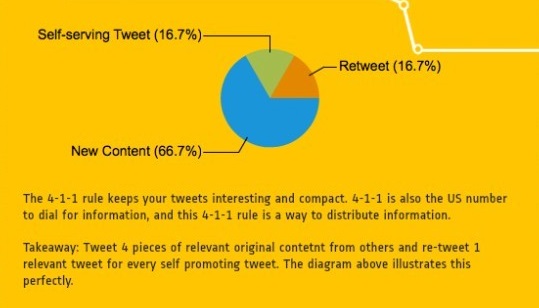
For every one tweet, post, or piece of content you create online that is “self-serving” (that is, really about marketing you and your organization), you should create 4 that are new pieces of just-plain-useful, value added content, and 1 that is a retweet or repost of something that your audience will find valuable.

There is a great infographic about this posted online at AdWeek’s Social Times.

I offer a quick look at it here, but you can check it out at the source with the link above.

4-1-1 rule of tweeting


How do you know if your video content is engaging?

videoWhat kinds of metrics will give you a quick feel for how interesting and engaging your content is to viewers?

A common mistake is to accept the number of views for your online videos as a clear indication of success. It’s quite possible for visitors to click on your video by mistake, have it automatically open when shared on Facebook, or check it out only to close it again within seconds.  These views can inflate your statistics without proving out the actual value of your video.

Similarly, the number of shares may not tell you what you’d like to know. There are any number of reasons that viewers may share your video (and not all are positive).

For a more reliable indicator of engagement and value, think about focusing on a metric like watch time.  If you launch your videos on your YouTube channel, you can easily run a watch time report on your content assets.  YouTube offers fairly straightforward instructions on running a report online.

Think about how many viewers are watching your videos for 30 seconds or more. Better still, how many are watching the videos through to the end?  Where in your video is the biggest dropoff occurring?  By paying attention to your analytics with regular reporting and assessment, you may be able to identify trends that will help you to improve on your scripting and video development, helping you to capture attention quickly and keep it through to the end.

So What? Writing about benefits v. features

Image of Post it NotesAs you develop your branding messages and work from that to create more specific messages about what you do, always keep in mind that you are addressing your customers – and that they are looking for a solution to a problem.

While it’s important when designing a service to understand how the features of your service make it (and you) distinctive), be careful not to leave your marketing message there.  It’s only the first step in communicating effectively.

Features describe the content of the service or product: what does it do, what does it have, how does it work?

Features are important to the customers who will choose you from an array of options. Anyone who has referred to Consumer Reports before buying a car or appliance knows that we all love comparison charts and checklists – and those are all about features.  But the reason that your customers are looking for a set of features is to solve a problem. Even in business, that problem is likely to have a business component and a personal component.  The more you know about both, the more you can resonate with your audience.

Benefits are what your services or products will help your prospect to do, They describe what the customer wants to accomplish and how they will help to get there. This is the business or work goal that you designed for.

Best of all is when you understand your customer well enough to go deep, and speak to their personal motivation in the matter. People make decisions and selections in their professional lives all the time based on emotional and personal responses, justified with logical processes. Understanding what they are really feeling helps you to describe not just a benefit, but a really good benefit.

Good benefits address your customer’s motivation and personal investment in their project or goal, and identify meaning on a more emotional level.

I love Post it® Notes, so they’ll serve as a good example of features v. benefits here.

Feature:  Post it® Notes are designed in an array of colors and sizes that you can mix and match; and you can stick them in one place and then easily move them around when you change your mind about an idea.

Benefit: When I am designing a service, Post it® Notes allow me to work on ideas that have many parts and levels and capture evolving thought. They solve the problem of how to brainstorm together with a group without confusion or mess.

Good Benefit: Post it® Notes are an excellent collaboration tool that help me to lead while ensuring that I’m including all voices in the group in the process of creation, and discover ideas that I might not have otherwise surfaced.

Finally, when you are writing about your brand, product, or service, be mindful about going the extra mile to distinguish between serving up a list of features and really conveying what your offering will do for the customer; pragmatically and emotionally. As yourself:

  • So what? (ask it multiple times, not just once)
  • Why do they want that feature?
  • What are they trying to do that will make them choose this?
  • How do they want to feel about their project or goal – what are their personal motivations?
  • How will your offering create a positive emotional reaction for your customers?



Content Marketing: The secret sauce for non-profits

Content Marketing: secret sauce imageCheck out upcoming posts in a new category – Content Marketing.

Content marketing includes a great deal of the messaging you’ll put out on social media, as well as the stories I’ve talked about that tell the human side of your work.  It is much, much more than that, however.  It offers the opportunity and challenge for you to look at and create content in multiple media, in multiple ways, that adds real value to your communication.  We used to call it “soft marketing”.

Nothing is more powerful as a way to build your brand and extend your reach.

Here are a few quick perspectives on content marketing to kick us off.  These were offered on the NewsCred blog (www.blog.newscred.com) , which has some nice pieces on content marketing in general.

  1. Content Marketing is all the Marketing that’s left.” – Seth Godin
  2. We need to stop interrupting what people are interested in and be what people are interested in.” – Craig Davis, former Chief Creative Officer at J. Walter Thompson
  3. Content Marketing is a commitment, not a campaign.” – Jon Buscall, Head of Jontus Media
  4. Either write something worth reading or do something worth writing about.” – Benjamin Franklin
  5. You need to create ridiculously good content – content that is useful, enjoyable and inspired.” – Ann Handley, Chief Content Officer, MarketingProfs
  6. Traditional marketing talks at people. Content marketing talks with them.” – Doug Kessler, Creative Director and Co-Founder at Velocity Partners
  7. Content builds relationships. Relationships are built on trust. Trust drives revenue.” – Andrew Davis, Author of Brandscaping
  8. Content is the reason search began in the first place.” – Lee Odden, CEO of Toprank Online Marketing
  9. Brands need to take the phrase ‘acting like a publisher’ literally.” – Dietrich Mateschitz, CEO of RedBull


Ask not what the Press can do for you..

mediaAttended an interesting conference today produced by the Human Service Forum. The last session of the day offered a panel of local/regional members of the media, and they shared some illuminating thoughts, which I’ll pass on to you.  We heard from a regional news magazine, network television station, radio station, and local weekly and daily news representatives.  Some of what they had to say echoes the thoughts provided in my earlier post, on press releases.

In addition, just a few underscores that are really helpful. For those sending press releases, announcements, and even photos, by way of pushing content to the media:

  • Find out what your chosen media outlet wants to report on before you send releases, and tailor them to both the style and the type of content they are seeking.  Many news outlets have had to cut back on reporters in this recession, and they do welcome articles that are well written, in their style (safe to use AP style), without a lot of gimmicky formatting. Keep it simple and information based.
  • Interesting nugget from one news representative: reporters are often (most often) not in the office, and functioning virtually via mobile devices.  If you are sending a press release, it may be optimal to copy and paste it into your email. Sending the release as an attachment just means the reporter has to have the capability of opening whatever format your file takes – and they may not be able to do it.
  • Keep your news timely and, if you can, tie it to current events. Most panelists said they receive at least 100 press releases a day. And while they are happy to get them, they won’t use all of them.
  • Photos are OK, even good, to send. But if you are going to send a photo, don’t send one that is substandard. It needs to be clear, and focused (not blurry), feature no more than 3 people in the photo (more is too many to distinguish in print), and carry the names of those pictured. 200 DPI jpegs, captioned, are best for the newspapers.

Relationships Matter.

Of particular interest to me was some discussion about establishing yourself as a source for the news media. Releases about your work and events are great, but to create a relationship where you become a trusted source, you should consider your role as a subject matter expert. One voice today spoke about creating a mindful strategy, where a nonprofit organization identifies those subject areas where they have real expertise; and then creates a media plan including monthly “news” releases sent to their targeted media connections that don’t necessarily have self interest in mind.  This begins to build an identity for you that says you are go-to source for expertise on a given topic (for instance, in my industry, education). If you do this, do your homework first. Your monthly “news” should attend to current events and strive to actually be helpful to reporters.

Once you have begun to be viewed as a go to source that can be relied upon for perspective, good information, and helpful quotes or interviews, you may be contacted for an interview as news breaks in your space. If this happens, make yourself available. Reporters seeking additional commentary on a story are on a short string – and they have looming deadlines.  Take the call, every time, and be available or make your experts available when needed.  It will pay off as your relationship with the press becomes less “push” and more “pull”.


Celebrate the troops

You have a great grasp of your customers and stakeholders, influencers and decision-makers; and you think you fully understand your target audiences.

Think again.

Are you remembering your own staff?

Your staff could be the single biggest messaging asset you have. If you are looking for champions in your tribe, who could be a more enthusiastic cheerleader about the work that you do than those folks that are doing the work themselves?

If they get it.

Your brand, your mission and your philosophy is hopefully something that your staff remembers to incorporate into their work every day. But too many companies and agencies, in hot pursuit of their customers or funders, do not take the time to tell the story at home.

It may be that your departments are siloed, and don’t really understand or hear about eachother’s work.  They may hear about what’s happening across the board, but not understand how it all hangs together to advance your mission.  If your mission is written in jargon or fails to tell the story of what you really believe, then perhaps they just don’t it at all.

Consider the small amount of time it takes to find just one story each week about something your staff has done – something extraordinary, or just something spot on – to support your mission. Do a shout out to all of your staff members. Give congratulations, and kudos – you can do this via email, interoffice memo, posting it on a wall or at a meeting – pick a method that isn’t time consuming. Do this every week, drawing attention back to how each of these acts supports and strengthens your real mission – and soon these little stories will build into a loyal internal fan base that knows your story and knows how to tell it.  More importantly, they’ll know how to live it.

Why is a tag line important?

Seems a bit silly to spend time sitting around trying to capture everything you are in 3 or 4 words. Your mission, values, and key benefits are much bigger than that – aren’t they?

Of course they are.

But the work that it takes to capture your essence in a sound byte is not at all silly; in fact, it’s an essential exercise in discipline. It can capture who your customers, members, and fans are; and it serves a very useful purpose in quickly uniting you with your tribe over your shared values.

  • Just do it (Nike)
  • Think different (Apple)
  • Because you’re worth it (L’Oreal)
  • You’re in good hands (Allstate)
  • Quality is job one (Ford)
  • It’s not just for breakfast anymore (Florida Orange Growers’ Association)
  • That was easy (Staples)
  • A mind is a terrible thing to waste (United Negro college fund)
  • Takes a lickin’ and keeps on tickin’ (Timex)
  • For a living planet (WWF)

Your mission, your promise and your brand

They are indeed complex, but place yourself in the mind of your customer and ask yourself “so what?” Then ask it again, and again. What can you come up with to answer it in 5 words or less?

Taglines are about making decisions.

Timex could talk about the visual beauty and simplicity of their watch design, the fact that their watches are an inexpensive, yet good value. So what? What do you really want in a watch, anyway? Timex watches are for people who don’t want a Rolex. Don’t want the bother, don’t want the expense, and don’t want to worry about damaging it. Just want it to tell time, reliably.

If you have done any strategic planning for your agency or business, you’ll likely have a mission statement, and core values – particularly if you are a non-profit. If you haven’t looked at those lately, take them off of the shelf and review them again. Non-profits spend a great deal of time arriving at a mission statement that is meaningful for them; and they are often excellent statements of purpose and approach. They are also (usually) somewhat wordy for the average stakeholder-on-the-street, and may not be at all memorable.

Try it. You’ll like it.