Category Archives: Content Marketing

2016 Research into Top Channels for Content Marketers

The Content Marketing Institute offers wonderful annual benchmarketing and research reports on their website.

researchTake some time to browse through these! Whether your focus is nonprofit marketing, B2B, or B2C, you’ll get some useful tips to live by along with a good idea of where you are compared to similar organizations.

For instance, the top 5 social channels that are being used this year by both B2B and B2C marketers are the same leading outlets: Facebook, Twitter, LinkedIn, YouTube, and Google+. LinkedIn is at the top of the list for B2B marketers, while Facebook still takes first place for B2C.

In 6th place for B2B marketers is Slideshare, while B2C marketers favor Instagram in 6th place.

In both cases, Instagram has seen terrific growth – its use is up 21 – 27% over last year.

While Google+ is widely used among both crowds, most think it is not effective. What is viewed as highly effective? The continuing stand-bys: LinkedIn, Facebook, Twitter, and YouTube.

Nothing like a Content Infographic

You could create a big spreadsheet to plan your content, or write out your strategy for using different content types, what your goals are for each, target audiences, and channels. I’ve done that more than once, and these are great documents for those with the time to wade through them.  But if you want your content strategy to be understood across your organization, by all those staff members that might be contributing – and if you want to keep the strategy and mix at the top of your own mind – than think about creating a more simple visual map to help you plan and monitor your content activities.

The Content Marketing Institute offers a great article (How to Use Visual Maps for a Balanced Content Marketing Strategy), with some examples of how you might map your content visually.  I love a good infographic, and some of the ideas they reference with examples from Smart Insights are great places to start. Here’s one:

smart-insights-content-marketing-template-image 1


The 411 of social media posts

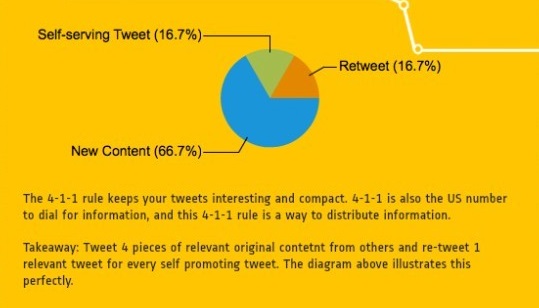
The 4-1-1 rule relates to best practices in using Twitter for your content marketing efforts; but it holds up well for any social media outlet that you’ll use on behalf of your organization. When you are planning and scheduling tweets, posts, or other types of content offerings online, this is a quick way to keep tabs on the kind of value you’re providing.

It goes like this:

For every one tweet, post, or piece of content you create online that is “self-serving” (that is, really about marketing you and your organization), you should create 4 that are new pieces of just-plain-useful, value added content, and 1 that is a retweet or repost of something that your audience will find valuable.

There is a great infographic about this posted online at AdWeek’s Social Times.

I offer a quick look at it here, but you can check it out at the source with the link above.

4-1-1 rule of tweeting


How do you know if your video content is engaging?

videoWhat kinds of metrics will give you a quick feel for how interesting and engaging your content is to viewers?

A common mistake is to accept the number of views for your online videos as a clear indication of success. It’s quite possible for visitors to click on your video by mistake, have it automatically open when shared on Facebook, or check it out only to close it again within seconds.  These views can inflate your statistics without proving out the actual value of your video.

Similarly, the number of shares may not tell you what you’d like to know. There are any number of reasons that viewers may share your video (and not all are positive).

For a more reliable indicator of engagement and value, think about focusing on a metric like watch time.  If you launch your videos on your YouTube channel, you can easily run a watch time report on your content assets.  YouTube offers fairly straightforward instructions on running a report online.

Think about how many viewers are watching your videos for 30 seconds or more. Better still, how many are watching the videos through to the end?  Where in your video is the biggest dropoff occurring?  By paying attention to your analytics with regular reporting and assessment, you may be able to identify trends that will help you to improve on your scripting and video development, helping you to capture attention quickly and keep it through to the end.

Blogging isn’t easy

For those of you who have blogs or are entertaining the notion, you are likely to encounter the age-old challenge that we all have.  There is never enough time.

For any social media outlet that you manage, it’s absolutely essential to create an editorial calendar.  Decide the frequency with which you’d like to post, the type of posts you’ll develop, and who will author the post if you have multiple authors.

Without a plan, you’ll quickly find yourself looking at huge long “posting gaps”.

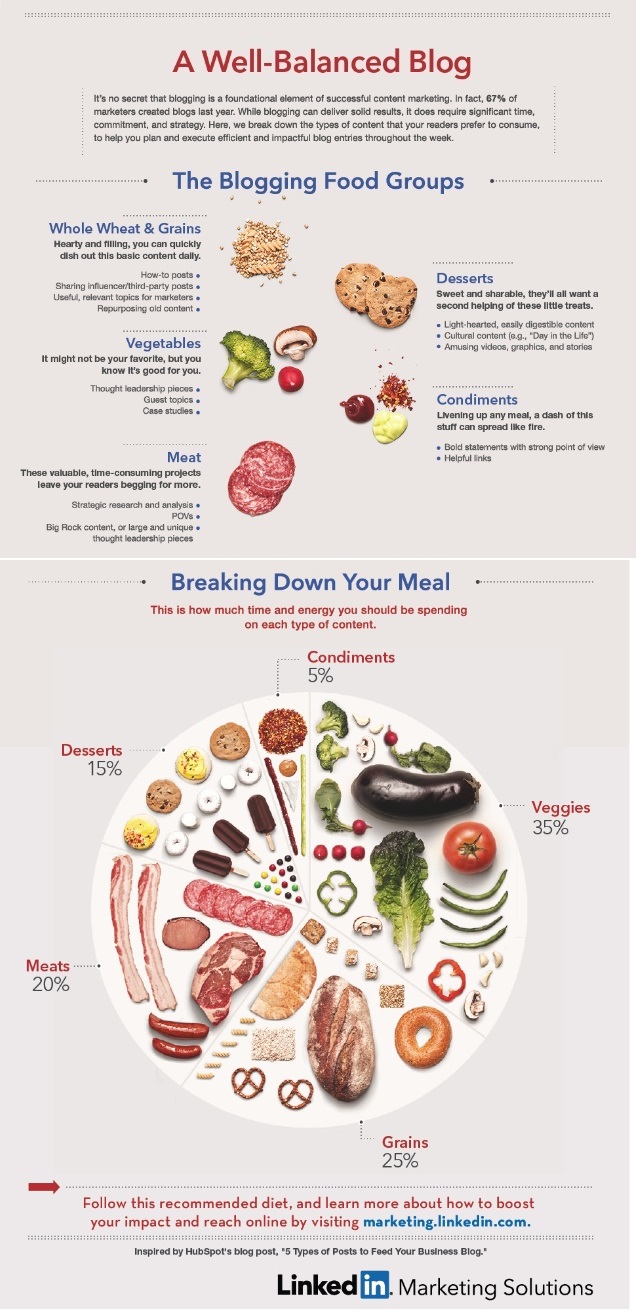
There’s a great infographic about this developed by LinkedIn Marketing Solutions.  It offers ideas about the different types of content you might offer, and encourages you to mix it up for a well-balanced content approach. I’ve pinned it to my office wall, in the hope that it will remind me to keep the faucet turned on and the content flowing – and I hope it will inspire you as well. Just click on the thumbnail to open the graphic, and have fun!

Well-balanced blog infographic from LinkedIn Marketing

From LinkedIn Marketing

Content Marketing: The secret sauce for non-profits

Content Marketing: secret sauce imageCheck out upcoming posts in a new category – Content Marketing.

Content marketing includes a great deal of the messaging you’ll put out on social media, as well as the stories I’ve talked about that tell the human side of your work.  It is much, much more than that, however.  It offers the opportunity and challenge for you to look at and create content in multiple media, in multiple ways, that adds real value to your communication.  We used to call it “soft marketing”.

Nothing is more powerful as a way to build your brand and extend your reach.

Here are a few quick perspectives on content marketing to kick us off.  These were offered on the NewsCred blog (www.blog.newscred.com) , which has some nice pieces on content marketing in general.

  1. Content Marketing is all the Marketing that’s left.” – Seth Godin
  2. We need to stop interrupting what people are interested in and be what people are interested in.” – Craig Davis, former Chief Creative Officer at J. Walter Thompson
  3. Content Marketing is a commitment, not a campaign.” – Jon Buscall, Head of Jontus Media
  4. Either write something worth reading or do something worth writing about.” – Benjamin Franklin
  5. You need to create ridiculously good content – content that is useful, enjoyable and inspired.” – Ann Handley, Chief Content Officer, MarketingProfs
  6. Traditional marketing talks at people. Content marketing talks with them.” – Doug Kessler, Creative Director and Co-Founder at Velocity Partners
  7. Content builds relationships. Relationships are built on trust. Trust drives revenue.” – Andrew Davis, Author of Brandscaping
  8. Content is the reason search began in the first place.” – Lee Odden, CEO of Toprank Online Marketing
  9. Brands need to take the phrase ‘acting like a publisher’ literally.” – Dietrich Mateschitz, CEO of RedBull


Audiences won’t wait- on your website or elsewhere

goldfishOn your website or in your offline communications, it will always be important to keep your communications simple, clear and direct – and ensure that your readers get what they came for in as little time as possible.

Why? There are all kinds of statistics and studies about the average attention span.

It’s shrinking. That’s important to you when you are looking to get a message across.

According to the attention span study published in early 2014; conducted by National Center for Biotechnology Information, U.S. National Library of Medicine, the 2013 average human attention span is now 8 seconds. In 2000, it averaged 12 seconds. And just for fun, the current average attention span of a goldfish is 9 seconds.

On the web, a recent U.K. Study found that the average person browsing the web switches between devices used to do so an average of 21 times an hour. When you are writing or designing for the web, take care to include key information front, and know where you want your visitors to next. Studies have shown that 32% of consumers will start abandoning slow sites (and slow searches) between one and five seconds. On a average web page with 593 words of text (and that’s not that much), visitors will likely read only about 28% of the words you have displayed.

Finally, if you use video content on the web, know that while images and video have tremendous power to tell a story, your script will need to be short. Viewers of videos on the web will on average watch for only 2.7 minutes before they tap out. And that statistic was gathered in studies that pre-dated the wide use and acceptance of Vine.  Vine videos are a maximum of 6 seconds. So, if you are putting the expense and time into taping a video that communicates your mission or service, keep it short.

This is great perspective to keep strongly in mind (post it on your office wall!) when you are designing or writing a web page. But it pays to realize that even offline, the impact of our online habit and behavior is impacting our collective patience. If you are not editing yourself, do that. Do it multiple times, and then ask someone else to read what you’ve written.

There’s no doubt that briefer communications will pay off in a better chance to capture your audience’s attention. But in addition, it is an expression of your respect for their time.

A picture is worth a thousand words

buildingYour brand promise is a lot more than a logo, tagline, home page, or picture.   But if you have not pursued some consistency in how you visually represent your brand; if there is dissonance between what you are trying to say and how you are saying it, then your underlying message about your commitment and your work will not be clear or convincing.

If you haven’t recently done an audit of your public facing messages and images for consistency with your branding message, it’s probably long overdue. Remember, though, that a visual audit proceeds from a strong brand statement.

Go back to your mission

Make sure that you’ve clearly identified your customers, influencers, and most importantly – who the people are that benefit from your work. Your visual messages should convey the heart of the work – what you hope to accomplish for those beneficiaries that your organization is passionate about.

Is your work about a building? Or is it meant to make lives better for people? If you are a nonprofit agency with a people-focused mission and your websites, brochures and media messages focus on your building; then you may be communicating pride of place. But you are not showing the heart of your work to your audiences.

Agencies that focus on educating kids and are not using visuals that keep the kids at the forefront are not only missing an opportunity to convey an important message about their mission. They are also taking a risk that the public will perceive their heart and their commitment to be in the wrong place. Materials, web pages, and commercials created to further ASPCA work don’t focus on the people. They focus on the animals. AARP does not show you lots of images of small children, but rather vibrant, aging retirees.

And unless you are Habitat for Humanity, consider keeping pictures of a building in the background, not the forefront, of your message.

A note about locating images for your work

If you lack the available resources to take your own photos of your work, you can start with stock images. Both istockphoto.com and shutterstock.com offer fairly inexpensive images for download and use. If you can find one or more images there that do a good job of showing off your work and your audience, it can start you off. Searching these sites may also help you to identify what you want to ideally convey that you can’t find in stock photos; and will need to pursue on your own. The downside: you may not be the only one using a stock image. The upside: commercially available photographs have all their ducks in a row as far as model/subject releases are concerned. If you take your own photos and people are the subjects, you should always get permission from the subject to use the image (or their parent/guardian, if they are a minor).


What is your customer’s story?

storytellingThe power of personal stories can create a visceral understanding of your brand and its value that are difficult to achieve in any other way. They can help to provide a clear understanding of what is at the core value of your brand that is unique and makes you stand out from the crowd.

How do you communicate your customers’ experiences, and why? You could load prospects up with a list of features, talk about key benefits, and describe for them the problem/solution set that your offer provides.

Or you could tell a story in which they see themselves.

If your organization hasn’t yet figured out how to reach out to your customers in a dialogue about what they truly love about your brand (and what they don’t), well, you are in good company. But you can’t afford to wait to seek out those voices and those stories. And if you already have, make sure that you have an ongoing process in place to keep talking.

Many organizations have evolved to the point of conducting customer satisfaction research, event, service and product evaluations, and even collecting testimonials from their customers.  These are all worthwhile activities – lending credibility to the assertion that your service has been successful for your customers, and can be so for others.

But to communicate to both your own organization and others outside your organization the true benefits of your work – the ways in which what you do changes lives – there is nothing more illustrative than a story told by your customer.

A compelling story is one in which we care about the storytellers, and we see ourselves in their faces. If your relationships with customers and members are too distant to know those stories, then you have larger problems than marketing mix. It’s possible you have lost sight of what the real benefit is to your  work. If that is true, my best suggestion is to meet and talk face-to-face with your customers.

Don’t sell it.

If you are thinking of using customer profiles, case studies and stories to strengthen your brand; be very careful about coupling these with a sales message. Stories are compelling stuff; but believability is at the heart of their power. A customer story is not a testimonial, it’s much bigger than that.  It goes to the heart of your brand and values.